
By Dr. Matthias Wiederholz with Performance Pain and Sports Medicine
Quadruple Board-Certified in Physical Medicine & Rehabilitation, Sports Medicine, Pain Medicine, and Regenerative Medicine
Updated February 12, 2026
Medically reviewed and updated for accuracy
Quick Insights
Collagen is the most abundant structural protein in your spinal discs, and the best collagen supplements for a herniated disc may support the body’s natural repair processes. However, oral collagen supplements alone cannot seal annular tears or reverse disc herniation. Hydrolyzed collagen peptides and undenatured type II collagen (UC-II) show the most promising evidence for musculoskeletal support. When supplementation is not enough, physician-led interventions that directly promote collagen regeneration within the disc offer a more targeted pathway to recovery.
Key Takeaways
- Spinal discs are composed primarily of type I and type II collagen, which provide structure and shock absorption.
- Degenerative disc disease involves progressive collagen breakdown in the annulus fibrosus and nucleus pulposus.
- Hydrolyzed collagen peptides and UC-II supplements have shown benefits for cartilage and connective tissue health in clinical research.
- Omega-3 fatty acids, glucosamine, and vitamins C and D complement collagen supplementation for disc health.
- When supplements alone are not enough, biologic treatments like the Discseel® Procedure directly stimulate collagen regeneration within damaged discs.
Why It Matters
Living with herniated disc pain affects your ability to work, stay active, and enjoy time with the people you care about. Understanding how collagen functions in your spinal discs, and whether supplementation can genuinely help, empowers you to make informed decisions about your care. For patients whose pain persists despite conservative measures, knowing that advanced collagen-based repair options exist can provide a meaningful path forward.
Introduction: Does Collagen Actually Help a Herniated Disc?
As an interventional spine specialist, one of the most common questions I hear from patients dealing with herniated disc pain is whether taking collagen supplements can help. It is a reasonable question. Collagen makes up a significant portion of your spinal disc’s structure, and logic suggests that supporting collagen levels should support disc health.
The short answer is that collagen supplementation may offer supportive benefits for spinal disc health, but it is not a standalone fix for a herniated disc. Research confirms that the intervertebral disc relies heavily on type I and type II collagen for its structural integrity and ability to absorb compressive forces. When this collagen breaks down, disc degeneration follows. However, whether an oral supplement can meaningfully reverse that process is a more complex question.
This article is written for patients who are experiencing herniated disc pain, degenerative disc disease, or chronic back discomfort and wondering whether the best collagen supplements for a herniated disc can make a real difference. I will explain what the evidence supports, which supplement types are most relevant, and when professional evaluation at Performance Pain and Sports Medicine becomes the better path to recovery.
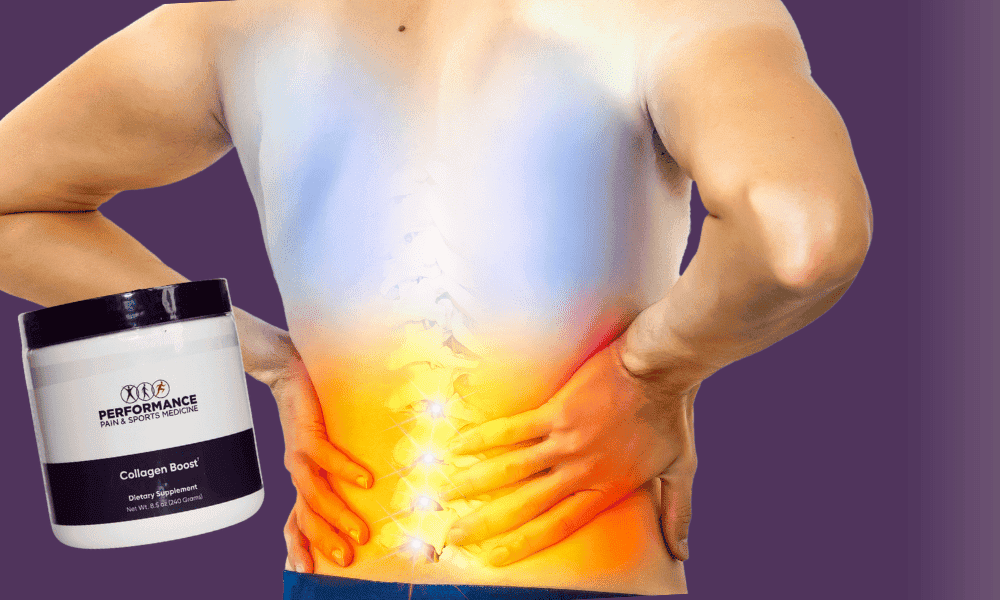
Why Collagen Matters for Your Spinal Discs
To understand whether collagen supplements can help your herniated disc, you first need to understand how collagen functions inside the disc itself.
Each spinal disc has two main components. The outer ring, called the annulus fibrosus, is made primarily of type I collagen arranged in concentric layers that provide tensile strength and contain the inner material. The inner core, called the nucleus pulposus, is rich in type II collagen and proteoglycans that retain water and give the disc its shock-absorbing properties.
Think of the disc like a pressurized tire. The outer collagen layers (annulus) keep everything contained, while the inner gel (nucleus) cushions the load. When those collagen layers weaken or tear, the inner material can push outward, creating a herniation that irritates nearby nerves.
The nucleus pulposus contains 66 to 86 percent water, with type II collagen and proteoglycans forming the structural framework that maintains hydration. This composition is what allows your discs to absorb the compressive forces of daily movement. When collagen integrity declines, the disc loses its ability to hold water and withstand loading, which accelerates the degeneration process.

How Collagen Breaks Down in Degenerative Disc Disease
Patients often ask whether collagen supplements can help degenerative disc disease specifically. To answer that, it helps to understand what is happening at the molecular level during disc degeneration.
Research has demonstrated that type II collagen becomes significantly downregulated in degenerative nucleus pulposus tissue. This means the cells within your disc are producing less of the collagen they need to maintain structural integrity. At the same time, inflammatory enzymes called matrix metalloproteinases (MMPs) actively break down existing collagen faster than the disc can replace it.
This imbalance between collagen production and collagen degradation is a hallmark of degenerative disc disease. More recent studies using collagen hybridizing peptides have confirmed that collagen degradation in the annulus fibrosus is significantly greater in degenerative discs compared to healthy ones. The collagen fibers that should be holding your disc together are literally unraveling.
This degradation explains why degenerative disc disease is progressive. As collagen breaks down, the disc loses height, the annulus weakens, and the risk of herniation increases. It also explains why there is interest in collagen-based approaches to slow or reverse this process.
The Best Collagen Supplements for Herniated Disc Support
Not all collagen supplements are created equal. If you are considering collagen for disc health, the type of collagen, its formulation, and the supporting evidence all matter.
Hydrolyzed Collagen Peptides
Hydrolyzed collagen (also called collagen peptides) is the most widely available and well-studied form. During hydrolysis, collagen proteins are broken into smaller peptide chains that the body can absorb more readily through the digestive tract. These peptides have been shown to accumulate in cartilage tissue after oral ingestion, which supports the biological plausibility that they could reach disc structures.
Most clinical research on hydrolyzed collagen has focused on joint cartilage and skin health, with positive results for reducing joint pain and improving connective tissue integrity. While direct evidence for spinal disc repair from oral collagen peptides remains limited, the mechanistic rationale is supported by disc biology research showing that collagen is the primary structural protein in both the annulus and nucleus.
Undenatured Type II Collagen (UC-II)
UC-II is a specific form of collagen that has not been broken down through hydrolysis. Instead, it works through a different mechanism: immune modulation. UC-II interacts with the immune system in the gut to promote tolerance to type II collagen, which may help reduce the inflammatory immune response that contributes to cartilage and disc degradation.
Clinical trials in osteoarthritis patients have shown UC-II to reduce joint pain and improve function at relatively small doses (typically 40 mg per day). Because the nucleus pulposus is rich in type II collagen, there is mechanistic interest in whether UC-II could help modulate the inflammatory processes involved in disc degeneration.
Which Type Is Best for You?
For patients primarily interested in providing building blocks for connective tissue repair, hydrolyzed collagen peptides (types I and II) at doses of 10 to 15 grams daily are the most practical option. For those focused on reducing inflammation-driven cartilage breakdown, UC-II at 40 mg daily offers a complementary approach. Some patients benefit from using both forms together as part of a broader supplement strategy.

Other Supplements That Support Herniated Disc Recovery
Collagen is not the only supplement worth considering for herniated disc recovery. Several additional nutrients play important roles in reducing inflammation, supporting cartilage health, and creating the conditions that allow collagen synthesis to occur.
Omega-3 Fatty Acids
Omega-3s, particularly EPA and DHA found in fish oil, have well-documented anti-inflammatory properties. Disc herniation triggers a local inflammatory cascade that irritates nearby nerve roots and produces pain. Omega-3 supplementation may help reduce this inflammatory burden, creating a more favorable environment for healing. Typical therapeutic doses range from 2,000 to 3,000 mg of combined EPA and DHA daily.
Glucosamine
Glucosamine is a naturally occurring compound involved in the production of glycosaminoglycans, the proteoglycans that work alongside collagen to maintain disc hydration and structure. While most glucosamine research has focused on knee osteoarthritis, the same biochemical pathways are relevant to spinal disc cartilage. Glucosamine sulfate at 1,500 mg daily is the most commonly studied dose.
Vitamin C
Vitamin C is essential for collagen synthesis. Without adequate vitamin C, the body cannot properly form the collagen molecules that maintain disc structure. Ensuring sufficient vitamin C intake (at least 500 mg daily) provides the co-factor your body needs to build new collagen from the amino acids provided by collagen supplements.
Vitamin D
Vitamin D deficiency is common among patients with chronic back pain, and low vitamin D levels have been associated with accelerated disc degeneration. Vitamin D supports calcium absorption, bone health, and the inflammatory balance needed for tissue repair. Most physicians recommend maintaining blood levels of 40 to 60 ng/mL through supplementation if dietary and sun exposure are insufficient.
For a more detailed guide on supplement protocols for spinal conditions, see our companion article on the best supplements for degenerative disc disease.

Nutritional Strategies to Maximize Collagen Benefits
Supplements work best when they are part of a broader nutritional strategy. The foods you eat every day either support or undermine your body’s ability to produce and maintain collagen.
Foods That Support Collagen Production
Bone broth, fish, chicken, and egg whites provide the amino acids (glycine, proline, and hydroxyproline) that serve as raw materials for collagen synthesis. Citrus fruits, bell peppers, and leafy greens provide vitamin C. Calcium-rich foods like yogurt, sardines, and fortified plant milks support the vertebral bone that surrounds and protects your discs. Dark leafy greens, berries, and fatty fish provide antioxidants and anti-inflammatory compounds that help protect existing collagen from degradation.
Foods That Accelerate Collagen Breakdown
Processed foods high in refined sugar can increase the formation of advanced glycation end products (AGEs), which directly damage collagen fibers. Trans fats and excessive omega-6 fatty acids promote systemic inflammation that accelerates collagen degradation throughout the body, including in your spinal discs. Excessive alcohol interferes with vitamin C metabolism and impairs the body’s collagen production capacity.
A whole-foods, anti-inflammatory diet provides the foundation upon which collagen supplementation can have its greatest effect. Without that foundation, supplements are working against a headwind of dietary-driven inflammation and collagen damage.
When Supplements Are Not Enough: Understanding Disc Repair
Collagen supplements can provide supportive nutrition for disc health, but it is important to understand their limitations. Oral collagen does not selectively travel to your damaged disc and repair the annular tear causing your pain. Supplements support the body’s general connective tissue health, but they cannot direct repair to a specific injured structure.
For patients with persistent herniated disc pain that has not responded to conservative care (including physical therapy, anti-inflammatory medications, and supplementation), the question becomes whether there are treatments that can more directly promote collagen regeneration within the disc itself.
This is where biologic disc repair approaches like the Discseel® Procedure become relevant. The Discseel® Procedure uses a biologic fibrin sealant injected directly into damaged discs to seal annular tears and stimulate collagen regeneration at the site of injury. Unlike oral supplements that provide general nutritional support, this approach delivers repair materials directly where the collagen damage exists.
Research into collagen-based biomaterials for disc repair continues to demonstrate the potential for biologic approaches that promote matrix regeneration within degenerative discs. The Discseel® Procedure represents an application of these principles in clinical practice, offering patients a minimally invasive option that preserves spinal mobility while addressing the structural collagen damage at the root of their pain.
The fibrin sealant works similarly to the body’s natural wound-healing response. When you cut your skin, fibrin forms naturally to stop bleeding and initiate tissue repair. During the Discseel® Procedure, fibrin is injected into the torn disc to seal the defect and stimulate new collagen growth over the following months. This targeted approach goes beyond what oral supplementation can achieve.
If you are considering whether your disc condition may benefit from this type of intervention, complete our Discseel® candidacy form to start the evaluation process.

Building Your Supplement Strategy: A Practical Approach
Patients frequently ask me for a straightforward plan they can follow at home while pursuing conservative care. Here is a practical framework that combines collagen supplementation with the supporting nutrients discussed above.
Start with a foundation of hydrolyzed collagen peptides (10 to 15 grams daily), ideally taken with a source of vitamin C to support absorption and collagen synthesis. Add omega-3 fatty acids (2,000 to 3,000 mg EPA/DHA daily) to address the inflammatory component of disc pain. Consider glucosamine sulfate (1,500 mg daily) for additional cartilage support. Ensure your vitamin D levels are optimized through testing and targeted supplementation as needed.
This supplement regimen should complement (not replace) an anti-inflammatory whole-foods diet, appropriate physical activity, and any treatment plan your physician has recommended. Supplements are one piece of a broader recovery strategy, and their benefits are maximized when combined with comprehensive physician-guided care.
Patients with herniated discs should always discuss new supplement protocols with their physician before starting, particularly if they are taking blood thinners, have allergies, or are managing other medical conditions.
Conclusion: Collagen Supplements as Part of a Bigger Picture
Should you take collagen for a herniated disc? The evidence supports collagen supplementation as a reasonable, low-risk addition to your recovery plan. Collagen is the primary structural protein in your spinal discs, and providing your body with the building blocks to maintain and repair that collagen makes physiological sense.
However, it is equally important to recognize the limits of supplementation alone. Oral collagen cannot seal an annular tear, reverse a herniation, or halt advanced degenerative disc disease. For patients whose pain persists despite conservative care and supplementation, physician-led evaluation can determine whether the underlying structural damage requires targeted intervention.
At Performance Pain and Sports Medicine in Houston, I work with patients every day who have tried supplements, physical therapy, and other conservative measures without lasting relief. For qualifying candidates, the Discseel® Procedure offers a minimally invasive option that directly addresses collagen breakdown within the disc, promoting structural repair rather than just symptom management.
If you are living with persistent disc pain and want to explore whether your condition is suited for advanced disc repair, see if you are a Discseel® candidate or contact our team to schedule a consultation at our Houston location.

Frequently Asked Questions
Does collagen actually help a herniated disc heal?
Collagen supplements provide the amino acid building blocks your body uses to maintain connective tissue, including spinal discs. While they support general disc health, oral collagen cannot directly repair an annular tear or reverse a herniation. Think of supplementation as providing raw materials for your body’s ongoing maintenance processes. For structural disc damage, targeted interventions that deliver repair materials directly to the disc offer a more effective approach.
What is the best collagen for degenerative disc disease?
Hydrolyzed collagen peptides (types I and II) at 10 to 15 grams daily provide the most practical nutritional support for degenerative disc disease. Undenatured type II collagen (UC-II) at 40 mg daily may help modulate the inflammatory immune response involved in collagen breakdown. Combining both types, along with vitamin C for collagen synthesis, offers the most comprehensive supplementation approach for patients with degenerative disc concerns.
How long does it take for collagen supplements to work for back pain?
Most clinical studies on collagen supplementation for musculoskeletal conditions report improvements beginning at 8 to 12 weeks of consistent daily use. Results vary based on the severity of your condition, your overall nutritional status, and whether other inflammatory factors are being addressed simultaneously. Collagen supplementation is a long-term strategy rather than a quick fix for acute pain.
Can collagen peptides reach the spinal discs after oral ingestion?
Research shows that hydrolyzed collagen peptides are absorbed through the digestive tract and can accumulate in cartilage tissue. However, spinal discs have limited blood supply compared to other tissues, which means nutrient delivery to the disc is inherently slow. This is one reason why supplementation supports disc health over time but cannot rapidly repair acute damage.
What other supplements should I take alongside collagen for disc health?
Omega-3 fatty acids (EPA and DHA) reduce inflammation around irritated discs. Glucosamine sulfate supports the proteoglycan matrix that works alongside collagen in the disc. Vitamin C is essential as a co-factor for collagen synthesis, and vitamin D supports bone health and inflammatory balance. Together with collagen, these nutrients create a more complete foundation for disc health than any single supplement alone.
When should I see a doctor instead of relying on supplements for disc pain?
Seek physician evaluation if you experience progressive numbness or weakness in your legs, pain that worsens despite several weeks of conservative care, bowel or bladder dysfunction, or pain that significantly limits your daily activities. These signs suggest that structural disc damage may require professional assessment and potentially targeted intervention beyond what supplements alone can address.
This article is for educational purposes only and should not be used as a substitute for professional medical advice, diagnosis, or treatment. Always seek the advice of your physician or other qualified healthcare provider with any questions you may have regarding a medical condition or treatment options. Never disregard professional medical advice or delay in seeking it because of something you have read in this article.